
Behind the Brand: How OEM and Private-Label Manufacturing Shapes Hair Systems
When an international hair-replacement brand, salon group, distributor, or specialist retailer launches a new line of hair systems, the product may carry one brand name while being manufactured by another company.
This is where OEM, ODM, and private-label manufacturing become important.
Across the human hair industry, manufacturing partnerships allow brands to work with specialist factories that already have the skills, equipment, materials, and production capabilities needed to develop and manufacture hair patches, toppers, extensions, and other replacement systems.
While our previous instalment followed finished hair systems from the factory into international markets, this article looks at the relationship behind many of those products: how brands and manufacturing partners work together to turn specifications into finished products.
Understanding OEM, ODM and Private-Label Manufacturing
Although the terms are often used interchangeably, they can describe different types of manufacturing relationships.
- OEM (Original Equipment Manufacturing) generally refers to a manufacturer producing a product according to specifications provided by the brand or buyer. The manufacturing partner brings the production capability, while the buyer determines the required product specifications.
- ODM (Original Design Manufacturing) involves a greater contribution from the manufacturer in product development and design. The manufacturer may provide existing designs, technical knowledge, or development capabilities that the brand can adapt for its own market.
- Private-label manufacturing is a broader commercial model in which a manufacturer produces products that are ultimately sold under another company’s brand.
In practice, the exact arrangement can vary from one partnership to another. Some buyers provide highly detailed specifications, while others rely more heavily on the manufacturer’s technical experience.
From Product Idea to Factory Specification
The process often begins long before a production batch reaches the factory floor.
A brand may approach a manufacturing partner with a particular product concept or an existing system that needs to be reproduced or modified. The manufacturer then has to translate those requirements into practical production specifications.
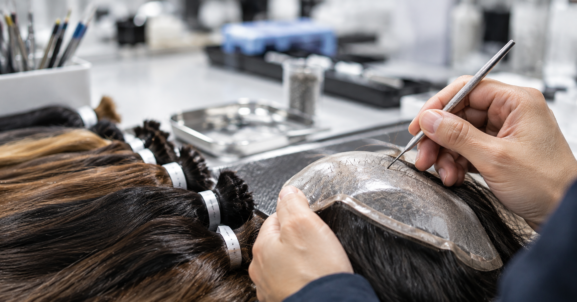
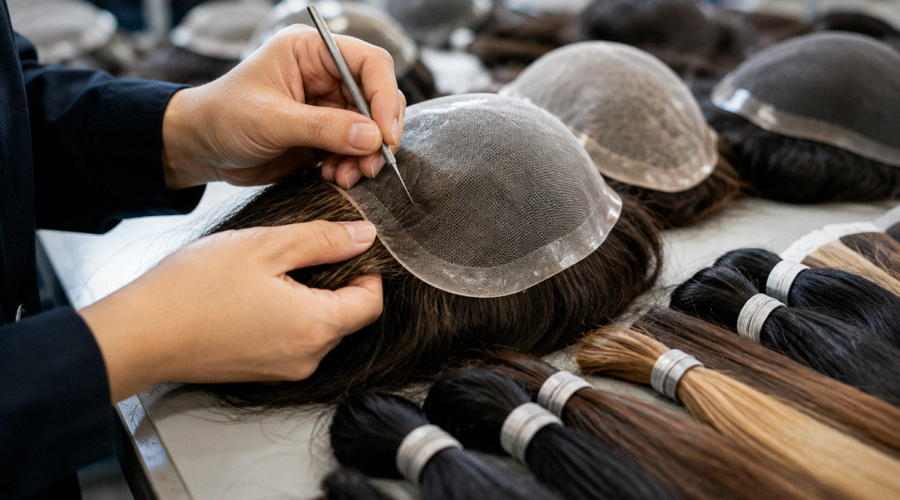
What sounds straightforward on a brand’s tech pack requires immense precision on the floor. For a hair system, this can involve details such as:
- Base dimensions and shape
- Base material and construction
- Hair length and density
- Colour and colour blending
- Curl or wave pattern
- Ventilation method
- Hair direction and placement
- Packaging and labelling requirements
These details may appear relatively simple from the outside, but each can affect the manufacturing process. A change in base material, for example, can influence ventilation techniques. A change in density can alter production time and labour requirements. Even adjustments to hair colour or curl pattern can require additional control during production.
This is why a successful OEM relationship depends on more than simply agreeing on a price.
Sampling Before Production
For customised products, the first production run is rarely the only step. Manufacturers and buyers commonly work through a sample and approval process before moving into larger-scale production.
A sample allows the buyer to evaluate the product against the agreed specifications and identify changes before those specifications are applied to a larger batch. For hair systems, this may involve reviewing the base construction, hair quality, density, colour, ventilation, hair direction, overall appearance, and packaging.
Once the specifications are approved, the challenge shifts from creating one acceptable sample to reproducing the same characteristics consistently across subsequent production. That transition from sample to repeatable production is one of the most important parts of contract manufacturing.
Consistency Becomes the Real Test
Anyone can build one flawless hair system. The real test of a manufacturing partner is doing it a thousand times over.
For brands selling under their own name, consistency directly affects the customer experience. Variations in colour, density, base construction, hair direction, or overall finish can become noticeable when products are supplied repeatedly over time.
Manufacturers therefore need processes that allow specifications to be documented and reproduced across production batches. This is where production records, quality checks, experienced technicians, material control, and inspection procedures become important.
For an international buyer, the value of a manufacturing partner is therefore not only its ability to make a product, but its ability to make that product consistently.
The Importance of Confidentiality
Private-label manufacturing also creates another important consideration: the relationship between the manufacturer’s capabilities and the brand’s identity.
A brand may have developed its own product specifications, packaging, colour combinations, base designs, or other elements that differentiate its offering. For these partnerships, confidentiality and clear agreements around the use of product specifications and brand materials can become important parts of the commercial relationship.
The exact arrangements will differ between businesses, but long-term partnerships generally depend on both sides understanding what information, designs, materials, and branding elements can be used and where. Trust therefore becomes an important part of the manufacturing relationship alongside production capability.
Scaling the Partnership
The requirements of a manufacturing partnership can also change as a brand grows.
A small initial order may focus primarily on sampling, product development, and establishing production specifications. As demand increases, the manufacturer may need to manage larger production volumes, additional product variations, tighter delivery schedules, and more complex quality-control requirements.
For the buyer, this creates a different set of questions:
- Can the manufacturer maintain quality as volumes increase?
- Can customised specifications be reproduced reliably?
- Can the production schedule support the brand’s market requirements?
- Can the manufacturer accommodate future product development?
These considerations can become just as important as the initial product price when selecting a long-term manufacturing partner.
From Supplier to Manufacturing Partner
The strongest OEM relationships tend to develop beyond a simple buyer-supplier arrangement.
When manufacturers contribute technical knowledge, production experience, sampling support, quality control, and problem-solving capabilities, they can become an important part of a brand’s product-development process.
For manufacturers in major production hubs across Asia, this creates an opportunity to compete not only on production cost but also on technical capability, consistency, flexibility, and service. For international brands, the right manufacturing relationship can provide access to specialised production capabilities without requiring them to establish and operate their own manufacturing infrastructure.
The relationship therefore works both ways: manufacturers gain access to international markets, while brands gain access to specialised production expertise.
Looking Ahead
The human hair systems industry increasingly sits at the intersection of manufacturing, branding, design, and international trade. Behind a finished product carrying a familiar brand name may be a network of designers, technicians, material suppliers, quality-control teams, and manufacturing partners working together to produce it consistently.
Understanding that relationship gives a clearer picture of how the modern hair systems market operates.
In the next instalment of our human grooming series, we will move back onto the factory floor to examine the technology, tooling, and equipment supporting modern hair-system production, and how these developments are helping manufacturers improve precision, consistency, and production efficiency.