
The Wet-Drydock Dilemma: How Hydrojetting and Moisture-Cure Coatings Are Testing Industrial Brushes
If you spend time around industrial contractors, shipyards, and heavy maintenance projects, you will notice a significant shift taking place on the dock.
Traditional dry abrasive blasting, long a standard method for removing heavy coatings, corrosion, and contaminants from steel infrastructure, is facing increasing pressure from environmental requirements, dust-control challenges, containment costs, and worker-safety considerations.
One technology gaining ground is ultra-high-pressure (UHP) hydrojetting. By using water at pressures that can exceed 30,000 psi, the process can remove old coatings, corrosion, and surface contamination while substantially reducing the airborne dust associated with dry abrasive blasting.
But hydrojetting creates another challenge for the teams responsible for applying the next protective coating.
The steel is wet. And once exposed, it can begin to develop flash rust.
That seemingly simple environmental variable is changing how coating systems are selected for wet surface-preparation environments, while also creating new demands on the tools used to apply them.
The Coating Challenge: Working With Moisture
Many conventional coating systems require carefully controlled surface conditions for reliable adhesion and curing. Applying an unsuitable coating to a damp or improperly prepared steel surface can lead to adhesion problems, blistering, premature corrosion, or eventual delamination.
For applications where completely dry conditions are difficult to achieve, moisture-tolerant and moisture-cure coating technologies offer an important alternative.
Single-component moisture-cure polyurethanes are particularly interesting because they use atmospheric moisture as part of their curing mechanism. Rather than treating humidity simply as an obstacle, the chemistry is designed to work with it.
For coating formulators, this represents an elegant response to a difficult field condition.
For the person applying the coating, however, it can create a very different challenge.
The Tool Reality: Pushing Coating Into Difficult Geometry
Even in highly mechanised maintenance operations, spray application cannot reach every surface effectively.
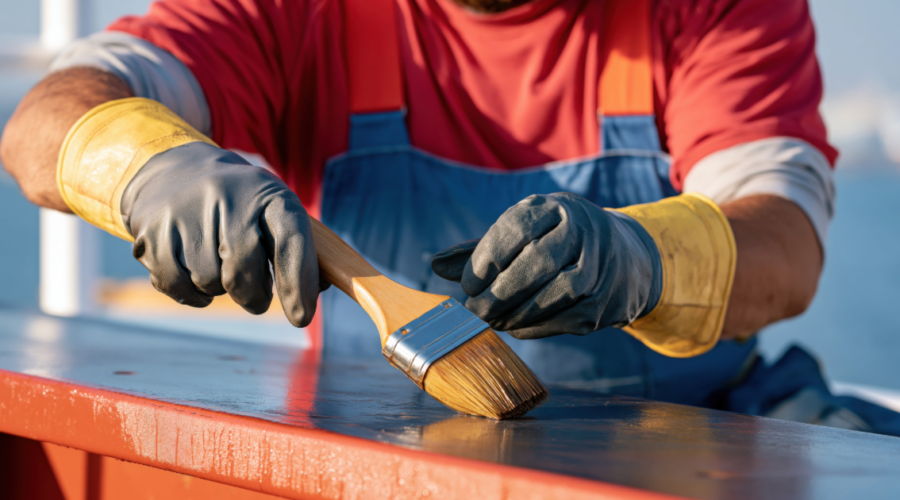
Welds, rivets, edges, corners, joints, recesses, and other complex geometries often require manual application or touch-up. In these situations, industrial-grade brushes and rollers remain essential tools.
This is where coating chemistry begins to intersect directly with brush manufacturing.
Depending on the formulation, high-solids and moisture-cure coatings can place considerable demands on an application brush. The combination of heavy-bodied material, solvents or other chemical components, repeated loading, and demanding working conditions means that the brush itself has to maintain its performance throughout the application process.
For the brush manufacturer, several characteristics become particularly important.
Chemical Resistance
The filament material needs to remain stable when exposed to the particular coating formulation being applied.
Poor compatibility can lead to changes in filament properties, including softening, swelling, embrittlement, or premature breakdown. The exact response depends on the chemistry of both the coating and the filament.
Stiffness Retention
Application brushes need sufficient backbone to work heavy coatings into uneven and pitted surfaces.
If filament stiffness changes significantly during use, the brush can become less effective at distributing the coating consistently, particularly when working across rough steel or into difficult surface profiles.
Shedding and Durability
A brush used for critical protective coating work needs to withstand repeated loading and application without excessive filament loss.
Loose filaments can become embedded in the coating film, creating an additional quality issue and potentially requiring rework.
For maintenance crews working against tight project schedules, premature brush failure also means more frequent replacement and additional interruptions.
What This Means for Brush and Filament Manufacturers
The evolution of surface-preparation and coating technologies is creating an interesting secondary effect: the application tool has to evolve alongside the coating system.
For brush manufacturers and filament producers, this means that material selection cannot be based solely on stiffness, cost, or appearance.
Filament compatibility with specific coating chemistries is becoming increasingly important.
Manufacturers supplying industrial application brushes may need to consider combinations of:
- Chemical resistance against the coating formulation
- Stiffness retention during prolonged use
- Dimensional stability under demanding conditions
- Low shedding for critical coating applications
- Durability during repeated loading and application
- Consistent filament quality across production batches
This is particularly relevant as industrial maintenance moves toward coating systems designed to perform under less-than-ideal field conditions.
The challenge is no longer simply to manufacture a brush that can hold and spread paint.
It is to engineer a brush whose filament, construction, and performance characteristics are compatible with the increasingly specialised chemistry being applied.
The Bigger Picture
Hydrojetting and moisture-tolerant coating systems are part of a broader evolution in industrial maintenance.
Surface preparation is becoming more controlled. Coating formulations are becoming more specialised. Environmental and workplace requirements are influencing how contractors operate.
And somewhere between the high-pressure water jet and the finished protective coating sits a deceptively simple piece of equipment: the industrial brush.
Its role may appear small compared with the machinery used for hydrojetting or the chemistry inside a modern protective coating. But when a contractor needs to work around a weld, reach a narrow edge, or push a heavy coating into a difficult surface profile, the brush remains an essential part of the process.
As coating technology continues to change, brush and filament manufacturers will increasingly need to understand not only how a brush performs, but what it is being asked to perform against.
In industrial coating applications, that distinction could become increasingly important.