

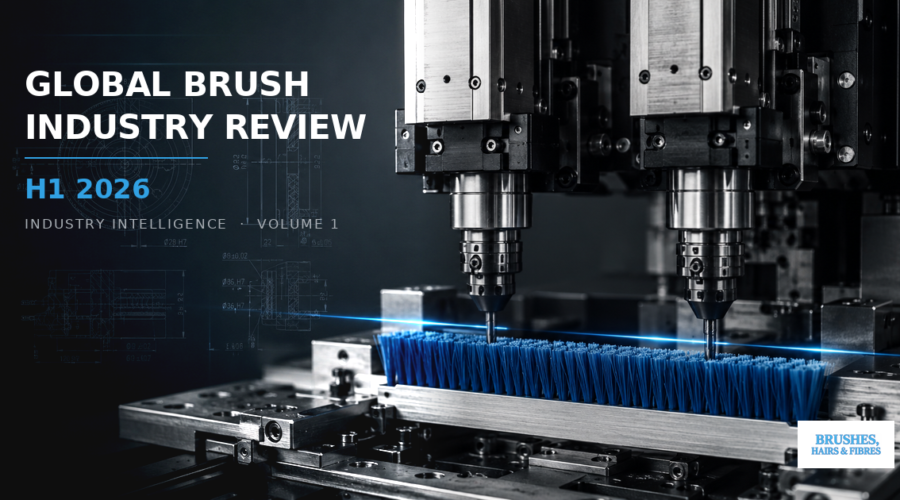
Global Brush Industry Review
H1 2026
Published: 26 July 2026
Edition: Volume 1 • H1 2026
Published by: Nawal Publications
Publication: Brushes, Hairs & Fibres
Prepared by: Editorial Desk, Brushes, Hairs & Fibres
Category: Industry Intelligence
Estimated reading time: 15–20 minutes
An Independent Editorial Review of the Global Brush Manufacturing Industry
“This biannual review highlights the most significant developments influencing the global brush manufacturing industry during the first half of 2026, providing manufacturers, suppliers, and industry professionals with an independent editorial perspective.”
“Operational resilience, rather than production volume, defined the first half of 2026 across the global brush manufacturing sector.”
Editor’s Note
In a specialised manufacturing sector driven by precision engineering, technical innovation, and global supply chain interdependencies, generic market overviews fail to serve the professionals who build this industry.
The first half of 2026 marked one of the most significant periods of operational change for the global brush manufacturing industry in recent years. Machinery innovation accelerated, supply chains continued to adjust to geopolitical realities, and sustainability moved from aspiration to measurable engineering practice.
This review is designed to cut through superficial market compilation. It offers a grounded, authoritative synthesis of what truly happened across our industry between January and June 2026 celebrating engineering excellence, analyzing machinery advancements, examining shifting trade patterns, and providing a clear-eyed roadmap for the months ahead.
Executive Summary
H1 2026 demonstrated that competitiveness in the global brush manufacturing industry increasingly depends on automation, supply chain resilience, and engineering innovation rather than production scale alone. Rather than coasting on steady demand, manufacturers faced immediate headwinds: shifting international trade dynamics, rising input costs driven by tariff adjustments, and mounting expectations for sustainable manufacturing practices.
Key developments defining H1 2026 include:
- The Dominance of Dual-Station Engineering: Machinery flagships such as ZAHORANSKY’s award-winning Z.WASP 1 redefined production efficiency by parallelizing drilling and tufting processes.
- Association-Led Resilience: At the 109th ABMA Convention in Puerto Rico, industry leaders confronted tariff volatility, intellectual property protection, and succession planning head-on.
- Regional Manufacturing Realignment: European machinery pioneers like Borghi SpA and KOTI Group continued to optimise localized support networks, while Indian manufacturing hubs accelerated their push toward digital transformation and export growth.
H1 2026 at a Glance
- 109th ABMA Convention: Convened in Puerto Rico with 151 participants across 48 companies.
- Innovation Recognition: ZAHORANSKY secured the William A. Cordes Innovation Excellence Award for the Z.WASP 1.
- Industry Milestones: Precision Brush Company celebrated 75 years of industrial engineering excellence in April 2026.
- Exhibition Milestone: Interclean Amsterdam 2026 highlighted surging global demand for durable industrial cleaning components in April 2026.
- Association Outreach: The European Brushware Federation (FEIBP) opened registration for its upcoming 66th Congress in Lyon.
Timeline
- January 2026: Borghi SpA strengthens regional support footprints across German, Austrian, and Swiss markets.
- March 2026: The 109th American Brush Manufacturers Association (ABMA) Convention convenes in Puerto Rico from March 24–27, 2026; ZAHORANSKY AG secures the William A. Cordes Innovation Excellence Award.
- April 2026: Interclean Amsterdam brings global cleaning and hygiene technology innovations to the forefront from April 14–17, 2026; Precision Brush Company marks its 75th anniversary.
- May–June 2026: The European Brushware Federation (FEIBP) advances preparations for its 66th Congress in Lyon; regional manufacturing hubs report continued export activity.
Major Industry Headlines
Navigating Tariff Volatility and Cost Realities
Heading into 2026, the most pressing operational hurdle cited by manufacturers has been the ever-changing international trade landscape. As association briefings during the spring convention season underscored, fluctuating tariffs have introduced acute cost pressures on raw material inputs, squeezing operating margins and forcing difficult pricing and sourcing recalculations. While these dynamics have offered localized protection for domestic producers in targeted regions, they have simultaneously accelerated the industry-wide push for supply chain redundancy and localized manufacturing partnerships.
Cybersecurity and Operational Risk
Beyond physical supply chains, H1 2026 forced industrial enterprises to harden their digital infrastructures. Component suppliers and machinery manufacturers issued recurring security advisories to safeguard commercial communications, supply chain contracts, and financial transactions against sophisticated social engineering and invoice fraud schemes. In an era where custom machine orders involve complex, multi-stage digital design handoffs, cybersecurity has firmly transitioned from an IT concern to an executive-level operational priority.
The Shift Toward Operational Resilience
One defining characteristic of H1 2026 was that manufacturers spent less time discussing production volume and considerably more time discussing operational resilience. Supply chain flexibility, digital infrastructure, workforce succession, and engineering efficiency emerged as recurring themes across association meetings and corporate announcements.
Machinery & Automation
The narrative defining H1 2026 machinery development is clear: automation is increasingly viewed as a crucial prerequisite for manufacturers seeking consistent quality, reduced labour dependency, and maximized output efficiency.
Breakthroughs in High-Performance Production
The benchmark for technical innovation during this period was decisively set at the 109th ABMA Convention in Puerto Rico, where ZAHORANSKY was honoured with the prestigious William A. Cordes Innovation Excellence Award (“The Willie”) for the new generation of the Z.WASP 1.
Parallel Processing
The Z.WASP 1 impressed industry judges with a novel machine concept featuring two separate processing stations that parallelize drilling and tufting operations, effectively doubling output compared to conventional single-station systems.
Filament Flexibility
Designed for technical and household brushes, the system accommodates long filaments up to 700mm and incorporates an optional flat wire unit capable of processing up to four flat wire spools simultaneously increasing tuft stiffness for extreme industrial operating conditions.
High-Speed Execution
Operating with dual drilling units reaching up to 12,000 RPM and tufting tools achieving up to 200 bundles per minute (on the Z.WASP 1 variant), the machine underscores the industry’s migration toward intelligent, high-speed, multi-material flexibility.
Industrial Automation and Inspection Systems
Beyond tufting, machinery developers across Europe and North America focused heavily on inline optical quality control. Manufacturers increasingly reported investments in automated vision inspection systems designed to improve quality assurance and reduce production waste across high-speed channel strip and cylinder brush lines.
Filaments & Raw Materials
Material economics in H1 2026 remained a balancing act between traditional natural fibres and high-performance synthetic alternatives.
Natural Fibre Scrutiny and Synthetic Evolution
The sourcing of natural animal hair particularly high-grade hog bristles continued to face geographical concentration risks and stringent sanitary import controls. Consequently, extrusion specialists placed heavy R&D focus on advanced synthetic monofilaments. Modern extrusion lines are increasingly equipped with precision thermal regulation systems to eliminate diameter warping, ensuring uniform cross-sectional density whether producing crimped PBT, PET, or specialized nylon variants.
The Sustainability Mandate in Extrusion
Environmental compliance has moved from marketing rhetoric to an engineering parameter. Polymer suppliers in H1 2026 introduced verified bio-based thermoplastic elastomers and post-consumer recycled (PCR) resin blends specifically formulated for brush block and filament extrusion, supporting manufacturers aiming to meet tightening international eco-audits.
Trade Shows & Global Networking
The 109th ABMA Annual Convention
Convened from March 24–27, 2026, at the Hyatt Regency Grand Reserve in Puerto Rico, the 109th ABMA Convention reaffirmed its status as a vital strategic anchor for the North American and international brush community. Bringing together 151 participants across 48 companies, the event combined high-level educational sessions notably focusing on intellectual property protection and corporate succession planning with structured Face-to-Face supplier meetings. This rigorous, pre-scheduled rotational format allowed manufacturers and raw material suppliers to finalize annual procurement strategies with maximum efficiency.
Interclean Amsterdam 2026
Running from April 14–17, 2026, at RAI Amsterdam, Interclean Amsterdam served as a global showcase for the professional cleaning, hygiene, and floor maintenance sectors. For industrial brush manufacturers supplying rotary scrubber brushes, sweeping cylinders, and specialized janitorial components, the exhibition highlighted steady global demand for durable, water-saving, and long-wear synthetic fibre assemblies.
Company Spotlight
Precision Brush Company: 75 Years of Industrial Engineering
Milestone anniversaries in H1 2026 offered a powerful reminder of the industry’s deep roots. The Precision Brush Company marked its 75th anniversary in April 2026. Growing from its origins as a custom workshop in Cleveland into a globally recognized leader in industrial channel strip brushes based in Solon, Ohio, the company’s trajectory exemplifies the resilience and adaptability required to thrive across three-quarters of a century of shifting manufacturing paradigms.
European Machinery Leadership: Borghi and KOTI
European machinery stalwarts continued to refine their operational footprints. Borghi SpA, celebrating decades of brush-making machinery innovation, reinforced its strategic presence across the German, Austrian, and Swiss markets through targeted regional collaborations, ensuring that end-users receive rapid technical support and localized engineering integration. Similarly, KOTI Group advanced its technical strip and industrial brush engineering solutions, catering to specialized automation and sealing applications across European manufacturing sectors.
India in Focus: Manufacturing & Export Dynamics
As an increasingly vital node in global supply chains, India’s brush and filament sector experienced robust momentum through the first half of 2026. Increasing enquiries from Europe and North America indicate that buyers continue to diversify sourcing beyond traditional manufacturing centres.
- Sourcing Destination Advantage: Indian manufacturing clusters in states like Gujarat and Maharashtra are increasingly recognized by international buyers seeking diversified supply chains outside of traditional East Asian corridors.
- Automation and Shop-Floor Modernization: Mid-to-large-scale Indian brush manufacturers are progressively evaluating and adopting semi-automated and fully automated tufting lines to meet rigorous international tolerance standards.
- Export Activity & Destination Shifts: Exporters of household brooms, paint brushes, and specialized industrial twisted-wire brushes reported active engagement with Middle Eastern, European, and North American distribution networks.
- Digital Visibility and Global Outreach: Forward-thinking Indian suppliers with modern tufting capability, consistent quality systems, and stronger digital visibility appear well positioned to benefit from this structural shift, making it seamless for international procurement managers to audit compliance remotely.
Editorial Analysis: Five Things Manufacturers Should Watch During H2 2026
As the industry pivots into the second half of the year, the editorial desk at Brushes, Hairs & Fibres advises monitoring five critical vectors:
- Tariff and Trade Adjustments: Keep a close watch on shifting trade policies and regulatory updates out of major importing regions, which will continue to dictate raw material costing and margin protection strategies.
- Adoption of Multi-Station Automation: Following the industry-wide acclaim for dual-station innovations like the Z.WASP 1, expect heightened pressure on mid-sized competitors to evaluate high-speed, parallel-processing machinery to remain cost-competitive.
- Bio-Based Filament Scalability: Assess the commercial viability and customer acceptance of newly introduced recycled and bio-based polymer filaments as sustainability regulations tighten across international markets.
- Cybersecurity Discipline: Audit internal digital communication and supply chain invoicing protocols to insulate operations against increasingly targeted B2B phishing and financial fraud schemes.
- Strategic Positioning for 2027 Exhibitions: Begin early preparations for upcoming global trade fairs and association conventions, treating networking and direct supplier meetings as core capital investments rather than secondary calendar items.
What This Means for Manufacturers
As distilled from our H1 editorial analysis, five concise imperatives stand out for operators navigating the remainder of 2026:
- Invest in automation strategically: Prioritize high-speed, parallel-processing machinery to protect margins against labour constraints.
- Strengthen supplier diversification: Mitigate raw material tariff risks by building secondary and tertiary sourcing channels.
- Prepare for sustainability compliance: Integrate bio-based and recycled polymers early ahead of tightening international eco-regulations.
- Build digital visibility: Enhance online catalogues and technical specification sheets to capture international procurement demand.
- Prioritise cybersecurity: Protect proprietary engineering designs and financial workflows from advanced social engineering threats.
H2 Outlook
As manufacturers prepare for the remainder of 2026, success will depend on balancing automation, sustainability, resilient supply chains, and customer responsiveness. Companies investing today in technology and long-term partnerships are likely to be better positioned for future growth. The defining competitive advantage in 2026 will not simply be manufacturing capacity, but the ability to combine engineering excellence, resilient supply chains, digital capability, and long-term strategic partnerships.
Scope of this Review
This review focuses on commercial developments affecting the global brush manufacturing industry, including machinery, automation, raw materials, trade associations, exhibitions, and strategic manufacturing trends. It is not intended to provide financial forecasts or exhaustive market statistics.
Global Brush Industry Review Methodology
The Global Brush Industry Review | H1 2026 has been compiled through editorial analysis of publicly available information published between 1 January 2026 and 30 June 2026. Information was current at the time of publication.
Sources include:
- Official company announcements and press disclosures
- Industry association publications and convention proceedings
- Exhibition organizer documentation and show reports
- Technical product releases and machinery specifications
- Recognized trade publications and editorial analyses
This review is intended to identify strategic industry developments rather than provide exhaustive statistical market research.
Official Sources
Official company websites, industry associations, and exhibition organisers referenced during preparation include:
- American Brush Manufacturers Association (ABMA)
- ZAHORANSKY AG
- Borghi SpA
- KOTI Group
- RAI Amsterdam / Interclean
- Precision Brush Company
About this Review
The Global Brush Industry Review is a biannual editorial publication produced by Brushes, Hairs & Fibres under Nawal Publications. It provides an independent overview of major developments, technological advancements, market trends, and strategic issues influencing the global brush manufacturing industry.
This publication forms part of an ongoing editorial series documenting significant developments across the global brush manufacturing ecosystem. Published twice each year (H1 and Year-End), the review is intended to serve manufacturers, machinery builders, raw material suppliers, distributors, and industry professionals seeking a concise yet authoritative perspective on the sector.
Share this Review
If you found this review valuable, consider sharing it with colleagues, customers, or fellow professionals in the brush manufacturing industry.
Feedback & Corrections
We welcome factual corrections, industry updates, and suggestions for future editions. To submit industry news, announce product launches, share company milestones, contribute technical articles, request corrections, or enquire about advertising, please contact the editorial desk at editor@brusheshairsfibres.com.
Citation & Copyright
Suggested Citation
Brushes, Hairs & Fibres. (2026). Global Brush Industry Review: H1 2026 (Vol. 1). Kanpur, India: Nawal Publications.
Copyright Notice
© 2026 Nawal Publications. All rights reserved. Reproduction, distribution, or republication, in whole or in part, without prior written permission is prohibited except for brief quotations used for editorial or academic purposes with appropriate attribution.
Archive & Previous Editions
H1 2026 — Current Edition


Pingback: ZAHORANSKY Introduces Next-Generation Z.TUCAN for Automated Nail Polish Brush Production
Pingback: The Brush Tufting Machine: India's Smartest Low-Investment Manufacturing Opportunity
Pingback: Leadership Transition at ZAHORANSKY USA: Steve Bellocchio Appointed President