
Inside the Workshop: Technology, Tooling, and Equipment on the Modern Hair-System Factory Floor
When you look at a finished, custom-crafted hair system, whether it is an ultra-thin skin base or a complex fine-lace unit, it is easy to see only the artistry. Every single strand of hair appears naturally placed, flowing seamlessly as if it were growing straight from the scalp.
Behind that finished look, however, lies a careful combination of skilled handwork and specialized factory tooling. While the human hair industry remains deeply rooted in meticulous manual craftsmanship, the tools and equipment used on the factory floor have evolved. To meet global demands for precision, durability, and efficiency, modern manufacturing hubs rely on a practical blend of traditional techniques and advanced production equipment.
The Evolution of Ventilation Needles and Micro-Tooling
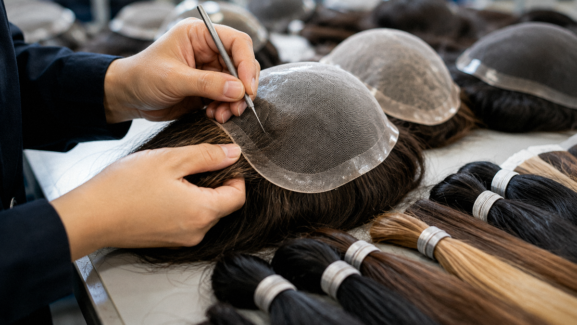
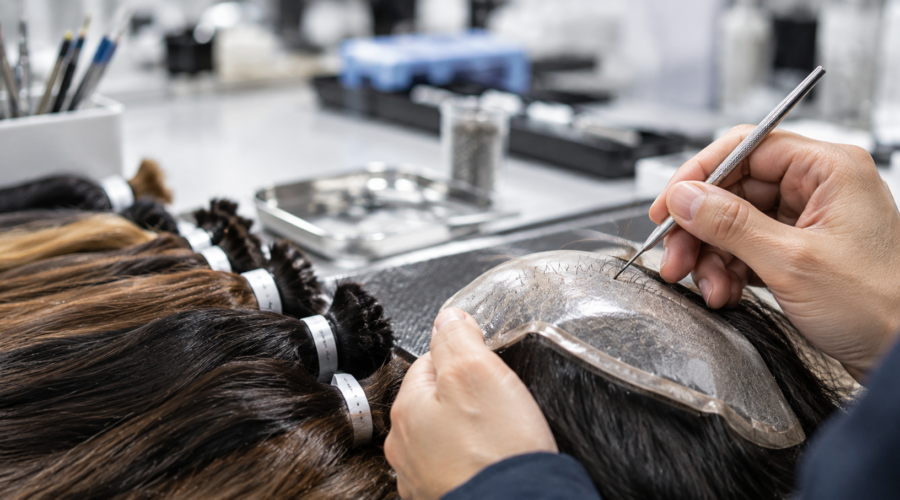
At the heart of any hair system production facility is the ventilation process. This is the method by which individual strands of hair are knotted or injected into the base material.
The tools used for this process have become refined over the years:
- Specialized ventilation needles, ranging from single-hair hooks to multi-hair split needles, dictate how tightly a knot can be secured and how flat the hair lies against the base.
- Micro-injection tooling, used for skin-base systems where hair is injected rather than knotted, employs precision thermal and mechanical micro-tools to embed hair follicles at the correct angle.
These small tool refinements have a direct impact on the longevity and natural movement of the final hair system.
Precision Cutting and Base Shaping Technology
Creating a base that matches a client’s specific contours requires exact dimensional accuracy.
Modern factories have moved past purely manual cutting for base shaping. The integration of precision cutting equipment, including automated laser-guided cutters and digital pattern-matching templates, ensures that lace, monofilament, and polyurethane bases are trimmed to exact millimeter specifications.
This technological step minimizes human error during the initial shaping phase, ensuring that every batch aligns precisely with the technical sheets provided by the brand.
Material Treatment and Quality Control Equipment
Before hair is ever ventilated into a base, it undergoes rigorous sorting, cleaning, and chemical processing to ensure uniform texture and color consistency.
On the factory floor, specialized testing and treatment equipment plays a critical role:
- Tensile strength testers evaluate hair elasticity and durability under physical tension.
- Color-matching spectrophotometers ensure dye lots match standardized international color rings precisely, reducing batch-to-batch variation.
- Thermal setting equipment sets permanent curl and wave patterns securely into the hair fibers without compromising structural integrity.
The Balance: Why Handcraftsmanship Remains Irreplaceable
Despite these technological advancements, the human hair system industry stands apart from traditional mass manufacturing because certain steps cannot be automated.
No machine has yet replaced the human eye and hand when it comes to replicating natural hairline graduation, multi-directional cowlicks, or delicate lace bleaching. The most successful modern factories view technology not as a replacement for human skill, but as a support system that enhances precision and reduces physical fatigue for master artisans.
Looking Ahead
As production hubs continue to modernize, the intersection of traditional craftsmanship and advanced factory tooling is redefining what is possible in non-surgical hair replacement.
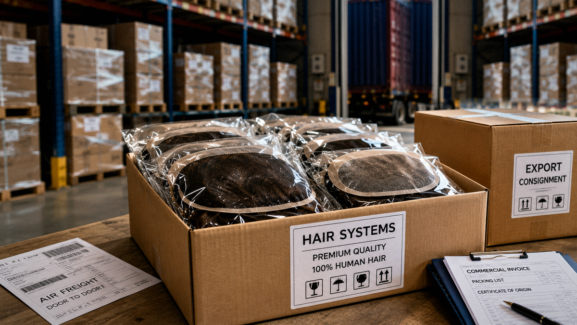
In our next segment, we will explore how these manufacturing efficiencies tie into global supply chain logistics, helping brands deliver custom solutions faster than ever before.