

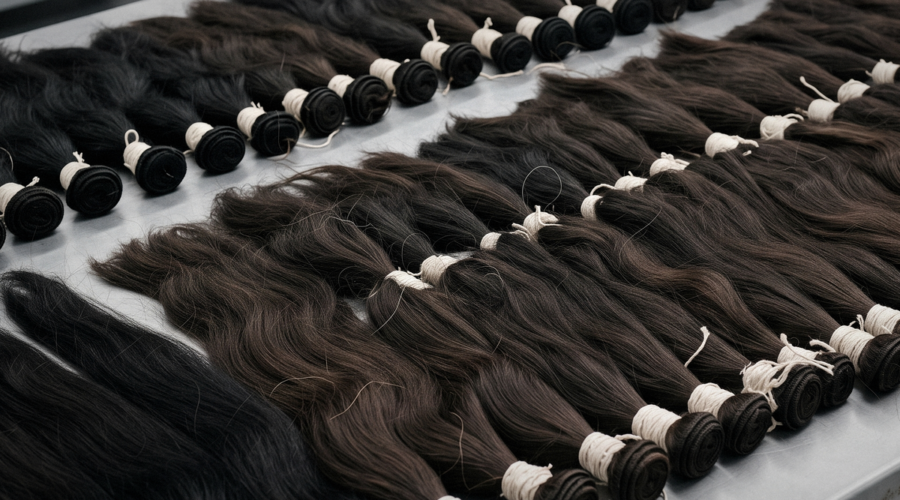
From Temple to Tress: How India Powers the Global Human Hair Supply Chain
When examining the global market for hair systems, extensions, and consumer hair patches, one country sits firmly at the centre of the supply chain: India.
As international OEMs, private-label brands, and salon groups continue to scale their businesses, understanding India’s raw human hair ecosystem provides valuable insight into one of the world’s most established manufacturing supply chains.
While consumer brands often dominate the spotlight, the industry’s foundation lies within a highly organised network of temple trusts, specialised processing facilities, skilled artisans, and export-oriented manufacturers that collectively transform donated hair into premium products sold across the world.
The Epicentre: Temple Tonsuring and the Gold Standard of Remy Hair
India commands a significant share of the world’s premium human hair supply through a tradition unlike anywhere else: religious tonsuring.
Every year, millions of devotees voluntarily donate their hair at temples across southern India, most notably at the Tirumala Tirupati Devasthanams in Andhra Pradesh, along with numerous temples throughout Tamil Nadu.
For manufacturers, temple hair is widely regarded as one of the highest-quality sources of raw human hair available for several important reasons.
Cuticle Alignment (Remy Integrity)
Temple priests secure the hair into bundles before cutting, ensuring that every strand remains naturally aligned from root to tip. This preserves the cuticle direction, significantly reducing tangling while improving colouring performance, durability, and overall product quality.
Virgin Hair Quality
Most donated hair has undergone minimal chemical treatment, resulting in stronger fibres with excellent tensile strength. This makes it particularly suitable for premium wigs, hair systems, extensions, toppers, and customised hair replacement products.
From Raw Hair to Industrial Processing
After institutional auctions, raw hair enters specialised processing clusters primarily located around Chennai and Hyderabad, with growing manufacturing activity in parts of West Bengal, including Midnapore and Chandipur.
The transformation from raw bundles into export-ready material involves several highly specialised stages.
Hackling and Length Grading
Hair is repeatedly drawn through fine metal hackles to remove short fibres and separate bundles according to length, texture, and quality.
Cleaning and Conditioning
Modern processing facilities employ carefully controlled washing and conditioning methods designed to remove impurities while preserving the natural strength and structure of the hair shaft.
Wefting and Preparation
Depending on the final application, processed hair is prepared for machine wefts, hand-tied wefts, lace systems, skin bases, monofilament foundations, or other specialised manufacturing requirements.
Powering Global Manufacturing
India’s importance extends far beyond its domestic market.
Manufacturers, distributors, private-label brands, and salon groups across North America, Europe, the Middle East, and Southeast Asia continue to rely on Indian processors for a consistent supply of premium human hair.
For many international brands, India remains the starting point of the manufacturing journey, even when the finished products are marketed and sold under foreign labels.
At the same time, the industry is evolving.
Increasingly, Indian manufacturers are moving beyond exporting raw and semi-processed hair by investing in value-added production, including finished hair systems, custom hair patches, toppers, extensions, and OEM manufacturing for global brands.
Why This Matters
For businesses operating across grooming products, brushes, beauty accessories, and related manufacturing sectors, the human hair industry offers valuable lessons in supply chain management, raw material grading, quality assurance, and value-added production.
Many of the same principles that define successful brush manufacturing, including material consistency, precision processing, engineering excellence, and export readiness, are equally important within the human hair industry.
Looking Ahead
India’s position within the global human hair industry has been built over decades through reliable sourcing, skilled craftsmanship, and manufacturing expertise.
Looking ahead, competitive advantage will increasingly depend on advanced processing capabilities, product innovation, automation, and the ability to deliver finished, high-value solutions rather than raw materials alone.
In the next instalment of this series, we will step inside the factory to explore how modern hair patches are manufactured, examining base materials, ventilation techniques, quality control processes, and the engineering behind today’s hair replacement systems.