
Beyond the Hair: How Quality Control Defines a Reliable Hair System
In the human hair industry, quality is often discussed in terms of hair origin, texture, softness and appearance. These characteristics matter, but they represent only part of what determines the quality of a finished hair system.
For manufacturers, exporters, OEM suppliers and international buyers, the finished product must also meet specific requirements for construction, density, colour, dimensions and overall workmanship. A system that looks satisfactory at first glance may still fall short if its base construction is inconsistent, its hair distribution differs from the approved sample, or its performance changes after routine handling.
As human hair systems move through increasingly specialised manufacturing and international supply chains, quality control becomes an important link between raw materials, production processes and customer expectations.
The challenge is not simply to produce one good unit. It is to establish a repeatable process that delivers products consistent with the agreed specification.
1. Quality Begins With the Raw Material
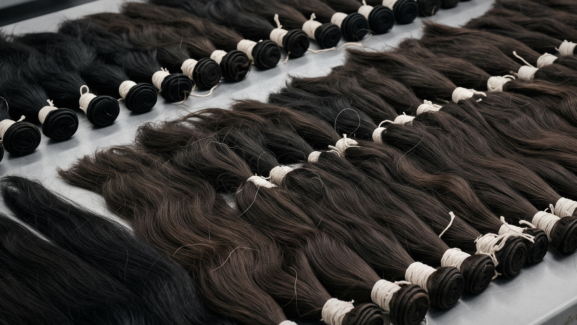
The characteristics of the finished system are influenced by the hair used to manufacture it. Length, colour, texture, strand condition and previous processing can all affect the material’s suitability for a particular application.
Manufacturers may receive hair from different sources and processing batches. Even when material is sold under the same commercial description, its characteristics should not automatically be assumed to be identical.
Terms such as virgin hair and Remy hair describe different characteristics and should not be treated as interchangeable quality guarantees. Buyers need clear information about the material being supplied, its processing history where available, and the specifications against which it has been assessed.
Incoming material inspection can help identify differences before production begins. Depending on the product, checks may include colour distribution, usable length, texture, cleanliness and visible signs of damage or inconsistent processing.
The objective is to establish whether the material is suitable for the intended product and whether it matches the manufacturer’s requirements before it enters the production process.
2. The Base Is as Important as the Hair
In a hair system, the base provides the structure through which the hair is attached and the finished unit is fitted or secured. Its material, dimensions and construction influence the product’s appearance, handling and suitability for its intended use.
Different systems may use lace, monofilament, polyurethane or combinations of materials. Each construction has its own requirements, so the same inspection checklist cannot be applied identically to every product.
Quality checks may include:
- Base dimensions and shape.
- Material consistency and visible damage.
- Edge finishing and seam integrity, where applicable.
- Ventilation, knotting or hair-injection workmanship.
- Hair direction and distribution.
- Construction details specified by the buyer.
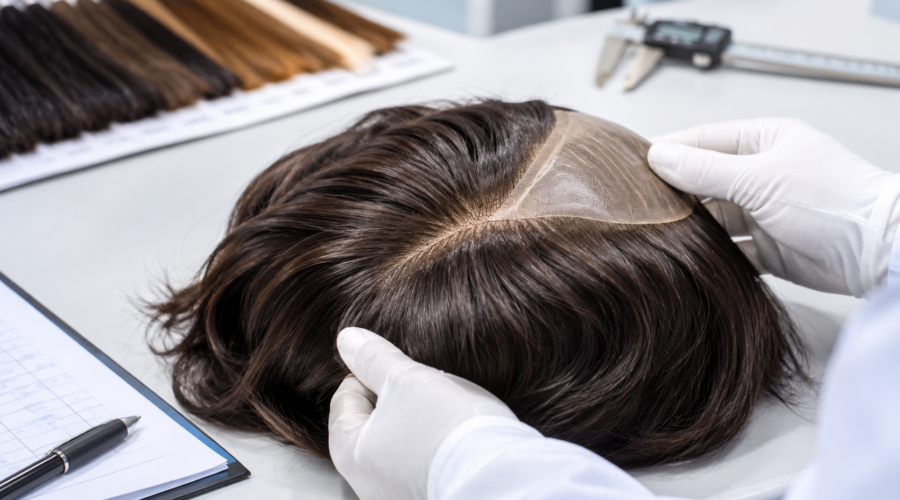
The hairline and parting area may require particular attention because small inconsistencies can affect the finished appearance. Density should also be evaluated across relevant zones rather than judged only by the overall volume of hair.
A well-constructed system brings these elements together. Hair quality alone cannot compensate for a base that fails to meet the agreed specification.
3. What Should Be Checked in a Finished Hair System?
Final inspection is the stage at which a manufacturer verifies whether a completed unit is ready for dispatch. The inspection should be linked to the product specification rather than relying exclusively on a general visual assessment.
Colour and texture: The finished product should be compared with the approved colour reference and texture requirements. Where possible, comparisons should be made under consistent lighting and using the same preparation method.
Density and distribution: Hair should be distributed according to the specified design. Differences around the hairline, crown or parting may be significant even when the total amount of hair appears acceptable.
Hair direction and ventilation: The direction, placement and attachment of hair should be reviewed against the design. Irregular knotting, visible gaps or inconsistent direction may affect appearance and styling.
Dimensions and construction: Base size, shape, edge finishing and other product-specific measurements should be checked against the order specification.
Shedding and tangling: Handling checks can help identify excessive loose hair, tangling or other concerns. The method used matters: observations should be recorded under an agreed procedure rather than interpreted in isolation.
Cleanliness and finishing: The unit should be inspected for visible residue, abnormal odour, unfinished areas, loose threads or other defects relevant to its construction.
Not every check applies to every product. The inspection criteria should reflect the design, materials and intended application of the hair system.
4. Testing Performance, Not Just Appearance
A finished unit can look satisfactory when it leaves the production line, but appearance alone does not establish how it will behave during normal use.
Manufacturers and buyers may therefore agree on additional checks appropriate to the product. These can include controlled combing, washing, drying or handling procedures, as well as checks on attachment construction and the stability of specified features.
For example, a washing assessment may be used to observe changes in texture, tangling or colour under defined conditions. A construction check may focus on the integrity of knots, seams, bonds or other attachment methods.
The important point is consistency. If two samples are evaluated using different procedures, the results may not be meaningfully comparable.
Before testing begins, the parties should agree on the procedure, the observations to record and the criteria used to assess the results. Where a product requires specialised performance testing, the relevant method should be documented rather than replaced with a subjective judgement.
A single inspection cannot predict every condition a hair system may encounter after delivery. Installation, maintenance, heat exposure, chemical treatments and handling can all influence later performance. Quality assessment should therefore distinguish between manufacturing conformity and performance under specific use conditions.
5. The Sample-to-Batch Challenge
One of the important challenges in hair-system manufacturing is maintaining consistency between an approved sample and subsequent production.
A sample may be developed through careful material selection and close supervision. Bulk production, however, involves multiple units, workers, processing stages and sometimes different material batches.
Without documented specifications and repeatable checks, differences may emerge in colour, density, dimensions, texture or construction.
A more controlled process starts with an approved physical sample and a written specification. The specification should identify the characteristics that matter for the order, including the relevant material, colour, length, density distribution, base construction, dimensions and packaging requirements.
Measurements and tolerances should be agreed in advance wherever they are applicable. Photographs can support inspection records, but they may not adequately communicate characteristics such as colour, texture, feel or flexibility on their own.
Manufacturers can also retain reference samples and inspection records to help compare subsequent production runs. If a specification changes, the revised requirements should be documented so that production and inspection teams are working from the same reference.
The goal is not to eliminate every natural variation in human hair. It is to identify which variations are acceptable for the product and which fall outside the agreed requirements.
6. Quality Assurance in OEM and Private-Label Manufacturing
Quality control becomes particularly important when a manufacturer produces hair systems for another company’s brand.
In OEM and private-label arrangements, the buyer may define product specifications, packaging, branding and other requirements while relying on the manufacturing partner to deliver the agreed product.
Responsibilities should be established before production begins. Both parties need clarity on sample approval, inspection criteria, permitted variations, packaging requirements and the process for handling non-conforming products.
A practical quality agreement may address:
- The approved physical sample and written specification.
- Material and construction requirements.
- Inspection procedures and acceptance criteria.
- Responsibility for final approval.
- Documentation and batch identification.
- Procedures for investigating defects or discrepancies.
- Approval requirements for changes to materials or construction.
If a shipment does not match the approved specification, the response should be based on documented observations. The affected products can be identified, the discrepancy recorded and the possible cause investigated before corrective action is agreed.
This process supports clearer communication between the manufacturer and brand owner. It also provides a more useful basis for repeat orders than relying on informal descriptions such as premium quality or salon quality.
For OEM suppliers, consistent documentation and inspection can become part of the service offered to customers, alongside product development and manufacturing capability.
7. A Practical Quality Checklist for Buyers
Before placing a substantial order or approving a new supplier, buyers can use the following questions to understand how quality is managed.
Material and specifications
- Is the supplied hair material clearly defined?
- Are colour, length, texture and density requirements documented?
- Is the approved sample retained as a reference?
Construction and workmanship
- Are the base material, dimensions and construction method specified?
- Are hair direction, density distribution and attachment quality inspected?
- Are product-specific defects identified through a written checklist?
Performance assessment
- Are washing, combing or handling checks relevant to the product?
- Are test procedures consistent between samples and production batches?
- Are observations recorded against agreed acceptance criteria?
Production consistency
- How is bulk production compared with the approved sample?
- Are inspection records retained?
- How are deviations and corrective actions documented?
OEM and delivery requirements
- Are branding, labels and packaging confirmed before production?
- Who is responsible for approving the finished goods?
- What happens if a delivered batch does not match the agreed specification?
The answers will vary depending on the supplier, product type and order size. The purpose of these questions is to establish whether quality expectations are clearly defined and supported by a repeatable process.
8. Building Quality Into the Manufacturing Process
Quality assurance is most useful when it is integrated throughout production rather than left entirely to the final inspection stage.
Incoming material checks can identify problems before processing. In-process inspections can reveal construction or density issues while they are still being addressed. Final inspection can then verify that the completed unit meets the requirements established for the order.
This approach also creates opportunities to investigate recurring defects. If the same issue appears across multiple units, inspection records may help identify whether it is associated with a material batch, a particular production stage or an unclear specification.
The appropriate level of documentation will depend on the scale and complexity of the operation. However, the underlying principle remains the same: decisions should be based on defined requirements and recorded evidence wherever practical.
For international buyers, this provides a clearer way to assess manufacturing partners. For manufacturers, it can help reduce avoidable disagreements, improve repeat-order consistency and make corrective action more systematic.
Conclusion: Consistency Is the Real Measure of Quality
The quality of a human hair system cannot be judged by softness, appearance or material description alone. It also depends on construction, specification compliance, workmanship and the ability to reproduce an approved product across successive orders.
As the industry serves a wider range of brands, distributors and professional buyers, quality assurance becomes an important part of the relationship between manufacturing capability and commercial reliability.
A good sample can demonstrate what a manufacturer is capable of producing. A well-defined quality process provides a stronger basis for understanding whether that result can be repeated.
For the human hair industry, the objective is therefore not simply to produce a finished system that looks right. It is to establish the standards, checks and documentation that help ensure the product delivered is the product the buyer approved.