

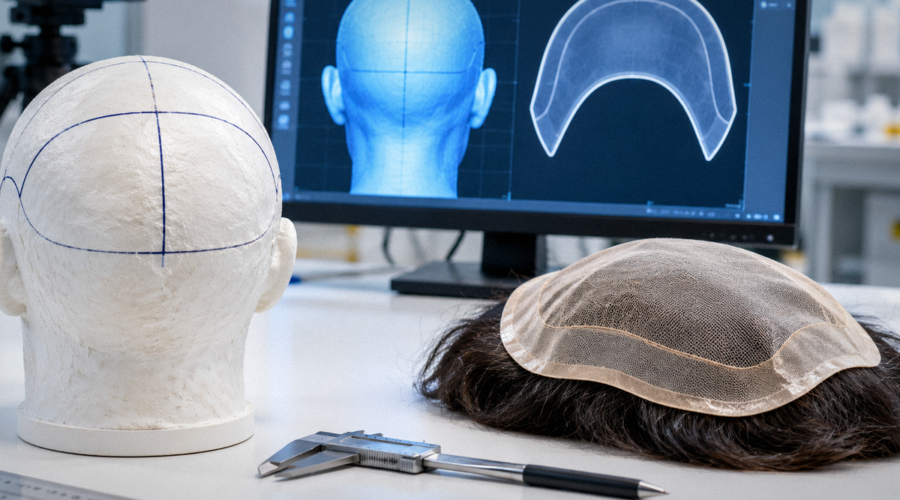
From Contour to Base: How Molds and Digital Templates Shape Custom Hair Systems
In manufacturing custom human hair systems, much of the industry’s attention focuses on hair quality, base materials, and ventilation techniques. Yet, before a single strand of hair is threaded or injected onto a base, a fundamental operational step occurs. That step is the creation and translation of the fit.
A hair system can feature premium temple-collected hair and flawless knotting, but if the base contour does not match the wearer’s scalp topology, the final product will fail in its primary function. Comfort, security, and natural appearance depend entirely on the accuracy of the initial measurements, molds, and templates sent from the salon or brand to the manufacturing floor.
For B2B buyers, salon distributors, and OEM manufacturers, understanding how fitting data is captured and interpreted is critical to reducing remake rates and ensuring consistent production.
1. The Anatomy of Scalp Topography
Human scalps vary significantly in curvature, contour, and dimensions. No two individuals share the exact same cranial geometry, which is why standard off-the-shelf units often require extensive cutting, thinning, or modification by a stylist.
Custom manufacturing eliminates this friction by building the base specifically to match the wearer’s head shape. However, capturing a three-dimensional curved surface requires precise data collection. Key dimensions typically include:
- Circumference and arc measurements: Mapping the distance from the front hairline to the nape, and from ear to ear across the crown.
- Contour definition: Identifying the exact position of the temples, the natural slope of the forehead, and the flat or curved areas of the crown.
- Density zones: Noting where the client requires specific contours, cowlicks, or hair growth patterns.
Without a standardized method for recording these measurements, variations occur between what the salon measures and what the factory produces.
2. Physical Molds: The Traditional Standard
For decades, the physical mold has been the reliable cornerstone of custom hair system manufacturing. Even as digital tools expand, physical casting remains widely used across global workshops.
A physical mold is typically created using a casting material applied directly to the client’s scalp or a fitted plastic wrap template. Once set, the mold captures the exact curvature and dimensions of the balding or thinning area.
When managing physical molds, several operational factors come into play:
- Material stability: Plaster, thermoplastic, or specialized casting wraps must maintain their shape during international shipping without warping or shrinking under temperature changes.
- Marking reference lines: The front hairline, ear tabs, and orientation markers must be clearly drawn directly onto the mold so factory technicians know how to position the base layout.
- Archival storage: Many manufacturers and brands retain physical molds or create digital backups to streamline repeat orders for the same client.
While effective, physical molds require physical logistics, international shipping times, and careful handling to prevent transit damage.
3. The Digital Shift: Scans and CAD Templates
As the industry modernizes, digital templating is transforming how shape data moves from the salon to the factory floor. Handheld 3D scanners, tablet-based mapping apps, and computer-aided design software allow practitioners to capture scalp contours digitally.
Digital templates offer several distinct advantages for supply chain efficiency:
- Instant transmission: Scan data can be transmitted to an overseas manufacturing partner via secure digital portals within seconds, eliminating international courier delays.
- Precision data storage: Digital files do not degrade, warp, or break during transit, ensuring exact reproducibility for repeat orders.
- CAD integration: Modern factories can feed digital contour files directly into automated cutting tables and laser-guided base trimmers, reducing human measurement error.
Despite these benefits, digital adoption varies across regions. Traditional salons often still rely on physical casting kits, requiring manufacturers to maintain dual workflows that accommodate both physical molds and digital files.
4. Translating Contour Data into Base Construction
Once the mold or digital file reaches the factory floor, it serves as the master blueprint for base construction. Translating a flat or contoured shape into a finished material like lace, monofilament, or polyurethane requires careful technical steps.
- Base blocking: The mold is mounted on a standardized or custom-shaped block that mirrors the client’s head contour.
- Material draping and stretching: Base materials are laid over the mold. Different materials behave differently under tension. Polyurethane skins conform smoothly to complex curves, while fine Swiss lace requires expert darting and stitching to eliminate wrinkles without distorting the mesh.
- Perimeter reinforcement: Edges, polyurethane perimeters, or-clip attachment points are aligned precisely with the boundaries marked on the original template.
If the template is misinterpreted during blocking, the resulting base will either pull uncomfortably on the scalp or leave gaps where the adhesive cannot form a secure bond.
5. Managing the Gap Between Salon and Factory
One of the most frequent sources of defects or remakes in custom hair system manufacturing is miscommunication regarding template markings. A line drawn in a salon to indicate a receding hairline can be interpreted differently by a technician in a manufacturing facility thousands of miles away.
To minimize these discrepancies, leading OEM suppliers and brands implement strict specification protocols:
- Standardized intake forms: Every mold or digital file must be accompanied by a completed specification sheet detailing exact measurements, orientation guides, and special instructions.
- Photographic verification: Requiring high-resolution photographs of the template placed on the client or head block before manufacturing begins.
- Clear tolerance guidelines: Defining what constitutes an acceptable deviation in base dimensions (for example, a tolerance threshold of plus or minus two millimeters).
Establishing these checkpoints prevents costly disputes over whether a finished unit was made incorrectly or whether the initial template measurements were inaccurate.
Conclusion: Fit is the Foundation of Reliability
Quality in human hair systems extends far beyond the texture of the hair or the strength of the knots. It begins with the geometry of the fit.
Whether captured through traditional plaster casts or modern 3D digital scans, the mold or template dictates every subsequent step in production. For manufacturers, mastering the translation of scalp contours into structural bases is essential for scaling operations. For international buyers and brand owners, partnering with suppliers who treat template verification as a rigorous scientific process is the key to delivering consistent comfort and reliability to the end consumer.