
Types of Industrial Brushes: Complete Guide to Applications & Materials
Industrial brushes are everywhere but rarely noticed. From production lines to cleaning systems, these brushes quietly play a critical role in keeping operations smooth, efficient, and precise.
Depending on the application, industrial brushes are designed in different shapes, materials, and configurations. Understanding these variations helps manufacturers and buyers choose the right solution for their specific needs.
What Are Industrial Brushes?
Industrial brushes are specially engineered tools used in machines or manual processes for tasks such as cleaning, polishing, deburring, sealing, or material handling.
Unlike household brushes, these are built for:
- High durability
- Continuous operation
- Specific mechanical functions
They are widely used across industries like automotive, metal processing, food production, and electronics.
Main Types of Industrial Brushes
Cylinder Brushes (Roller Brushes)
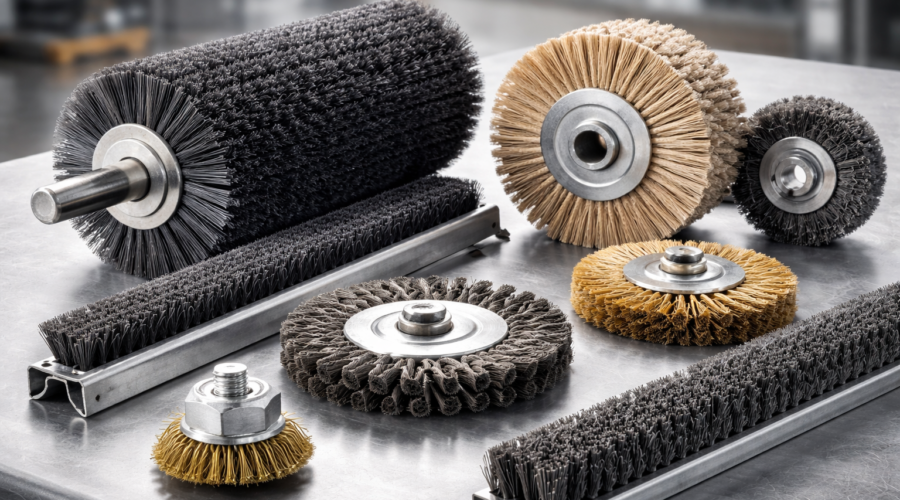
Cylinder brushes are one of the most commonly used industrial brush types. They are mounted on rotating shafts and are widely used in automated systems.
Applications:
- Conveyor cleaning
- Surface polishing
- Dust removal
- Food processing lines
Their design allows continuous operation, making them ideal for high-speed production environments.
Strip Brushes
Strip brushes consist of bristles held in a metal or plastic channel. They are flexible and can be mounted in straight lines or curved shapes.
Applications:
- Sealing gaps in machinery
- Dust control
- Edge protection
- Guiding materials on conveyors
They are especially useful where adaptability and space efficiency are required.
Disc Brushes
Disc brushes are circular brushes used either individually or in sets. They are commonly used in surface preparation and finishing processes.
Applications:
- Deburring metal parts
- Surface cleaning
- Polishing
- Edge blending
Their compact design allows precise control in targeted applications.
Wheel Brushes
Wheel brushes are similar to disc brushes but are typically used on handheld tools or machinery for aggressive cleaning or finishing.
Applications:
- Rust removal
- Weld cleaning
- Surface preparation
They are commonly used in metalworking industries.
Cup Brushes
Cup brushes are shaped like a cup and are mounted on tools for heavy-duty applications.
Applications:
- Removing coatings
- Cleaning large surfaces
- Heavy-duty deburring
They are designed for high-impact tasks requiring strong abrasion
End Brushes
End brushes are small brushes designed for precision work. They are used in hard-to-reach areas where larger brushes cannot operate.
Applications:
- Internal cleaning
- Fine deburring
- Detail finishing
They are widely used in electronics and precision manufacturing.
Materials Used in Industrial Brushes
The performance of a brush depends heavily on the material used for its filaments.
Common Materials:
- Nylon: Flexible, durable, widely used
- Polypropylene: Resistant to chemicals and moisture
- Steel wire: Used for aggressive cleaning and deburring
- Abrasive nylon: Contains grit for surface finishing
- Natural fibres: Used in specific applications like polishing
The choice of material depends on the level of abrasion, environment, and application requirements.
How to Choose the Right Industrial Brush
Selecting the right brush involves understanding several factors:
- Type of application (cleaning, polishing, sealing)
- Surface material
- Required level of abrasion
- Operating speed and environment
Using the wrong brush can reduce efficiency and even damage materials, making proper selection critical.
Applications Across Industries
Industrial brushes are used across a wide range of sectors:
- Automotive: surface finishing, cleaning
- Metal industry: deburring and polishing
- Food processing: conveyor cleaning
- Textile: lint removal
- Electronics: precision cleaning
Their versatility makes them an essential component in modern manufacturing systems.
Industrial brushes may seem simple, but their role in manufacturing and maintenance is highly specialized. From heavy-duty cleaning to precision finishing, each type of brush is designed with a specific purpose in mind.
As industries continue to automate and scale production, the demand for efficient and durable brush solutions is only expected to grow.
FAQs
Industrial brushes are used for cleaning, polishing, deburring, sealing, and material handling in manufacturing and maintenance processes.
It depends on the application. Nylon is commonly used for flexibility, while steel wire is preferred for heavy-duty tasks requiring high abrasion.
Industries such as automotive, metalworking, food processing, textiles, and electronics widely use industrial brushes for various specialized tasks.
Strip brushes are flexible and used for sealing or guiding materials, while cylinder brushes are rotating brushes mounted on shafts for automated cleaning and polishing.