
Decoding the Creative Market: What NAMTA 2026 Signals for Global Brush Manufacturers
The recent wrap-up of Creativation by NAMTA in St. Louis, Missouri (May 15–19, 2026) made one thing completely clear: the fine art materials sector is undergoing a massive structural shift. While consumer channels and art influencers are buzzing about 19 new POSCA colours, Faber-Castell’s 20 new Polychromos pencils, and trendy marker sets, the real story for global brush, hair, and filament manufacturers is happening entirely behind the scenes.
On the exhibition floor at America’s Center, the underlying trend wasn’t just about expanding colour lines- it was about application, material composition, and retail scaling. The creative materials market is shifting rapidly toward heavy-body acrylic mediums, specialized surface grounds, and an absolute explosion of private-label manufacturing driven by digital-first brands moving aggressively into brick-and-mortar spaces.
For upstream suppliers, these are direct commercial signals. Here is a practical breakdown of what these specific developments mean for your production lines and B2B strategy over the next year.
Key Strategic Signals from the NAMTA 2026 Exhibition Floor
1. The Chemistry Shift: Why Medium Innovation Demands Advanced Filament Blending
A major highlight of the St. Louis show floor was the continued expansion of specialized chemical mediums that change how paint behaves on a substrate, most notably exemplified by the massive interest in Daniel Smith’s Watercolour Grounds and heavy-bodied acrylic ranges from Winsor & Newton. These mediums allow artists to turn non-traditional surfaces like wood, canvas, and plastic into heavily textured, highly absorbent layers.
For brush manufacturers, this trend means standard, uniform hair profiles are facing strict performance limitations. When a consumer applies thick, abrasive grounds or high-viscosity hybrid paints, cheap off-the-shelf synthetic filaments split, fail to hold a point, or wear down rapidly.
The Manufacturing Takeaway
This diversification places immediate pressure on filament extruders and brush engineers. To secure premium contracts from legacy brands, global brush makers must move away from standard mono-diameter nylon or polyester fibres.
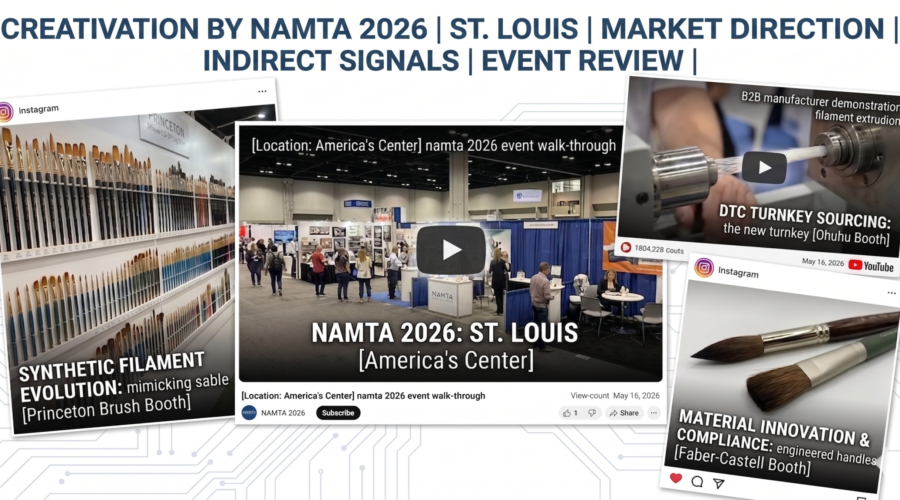
The commercial growth is entirely in engineering multi-diameter, wavy, and deeply tapered synthetic blends. Your production lines must focus on synthetic profiles such as specialized wavy filaments that mimic the exceptional liquid-carrying pockets of natural squirrel and sable while retaining the rigid structural backbone needed to pull heavy, gritty grounds across a canvas without degrading the brush head.
2. The Private Label Surge: The Reality of the Ohuhu, Meeden, and Grabie Boom
One of the most defining visual aspects of NAMTA 2026 was the sheer scale and footprint of digital-first, online-native brands like Ohuhu, Meeden, and Grabie occupying primary real estate on the international trade floor. These brands, which built their empires via e-commerce and algorithmic marketplace scaling, are now commanding major physical retail presence.
Their operational strategy offers a highly lucrative, high-volume roadmap for global contract manufacturers.
The Manufacturing Takeaway
These fast-growing brands are fundamentally marketing, community-building, and distribution engines; they do not own factories. Their entire business model relies on highly responsive, full-service contract manufacturing partnerships.
For global brush factories, this represents a major volume opportunity, but it requires a change in operations. These buyers aren’t looking to source loose components or raw filaments; they want complete, retail-ready, beautifully curated brush sets that can be packed, branded, and shipped efficiently. Winning this business requires offering end-to-end turnkey solutions: custom bristle blending, precision ferrule crimping, and highly flexible packaging configurations with scalable Minimum Order Quantities (MOQs) tailored for rapid e-commerce product rotations.
3. Performance-Driven Material Ethics: Synthetic Alternatives Take Centre Stage
The presence of dedicated brush innovators like FM Brush (Dynasty Brush), showcasing advanced synthetic alternatives at Booth #237 highlighted a mature market shift. Sustainability and ethical sourcing are no longer vague buzzwords relegated to cheap “eco” lines; they are now the baseline procurement standard for high-end professional tools.
As international regulations on natural hair import, handling, and tracking become increasingly strict, major art supply brands are actively trying to future-proof their supply chains.
The Manufacturing Takeaway
Succeeding in the modern regulatory environment requires serious material engineering. Global brush makers are seeing a sharp rise in demand for premium, proprietary synthetics that are explicitly labelled as “Faux Kolinsky,” “Faux Sable,” or “Faux Squirrel.”
To capture this margin, factories must invest in precision finishing. The aesthetic demands from premium buyers are incredibly high: manufacturers must pair these ethical filaments with sophisticated component styling, such as seamless matte-black ferrules, laser-etched branding, and specialized anodized nickel crimping that offers both high perceived retail value and the long-term ergonomic durability required by working artists.
Conclusion: Transitioning into an Irreplaceable Innovation Partner
The overarching lesson from the St. Louis show floor at Creativation by NAMTA 2026 is that the fine art sector is moving rapidly away from low-margin, commoditized supply chains. Brands are actively searching for performance stability, strict regulatory compliance, and extreme manufacturing agility.
For global brush manufacturers, long-term profitability lies in moving away from a passive “bulk component vendor” mindset. The factories that secure the most valuable contracts this year will be those that present themselves as proactive technical partners offering proprietary filament engineering, mastering turnkey private-label execution for digital-first giants, and providing the strict material transparency that the international creative market now demands.