
The Brush Tufting Machine: India’s Smartest Low-Investment Manufacturing Opportunity
This article lays out exactly why brush manufacturing represents one of the most compelling MSME manufacturing investments available to Indian entrepreneurs today – and why, if you are already in the household products business, the opportunity is even more immediate.
Technical Feature Contributed by
Rajiv Sanghavi
Managing Director, BORGHI India
Introduction: A Market That Cleans Up Every Day
Every Indian household – from a 1-BHK apartment in Mumbai to a farmhouse in Punjab – uses brushes and brooms every single day. The household cleaning tools market in India is neither seasonal nor cyclical, and it’s not going anywhere. Urbanization, modern retail expansion, and the post-pandemic surge in hygiene consciousness have together strengthened the broom and brush industry into one of the most stable consumer hygiene product segments in the country.
Yet household brush manufacturing remains one of India’s most underserved small industries – and that is precisely what makes it an ideal investment opportunity for a new entrepreneur.
1. Low Investment, High Potential: The ₹50 Lakh to ₹1 Crore Window
One of the biggest barriers to entering any manufacturing sector is capital. Heavy industry demands crores in plant, machinery, and working capital before a single unit ships. The brush manufacturing machine segment is fundamentally different – it is one of the rare small-scale manufacturing businesses where a fully operational, commercially viable factory can be set up within a budget of ₹50 lakh to ₹1 crore, inclusive of machinery, raw material stock, and initial working capital.
What Does That Investment Cover?
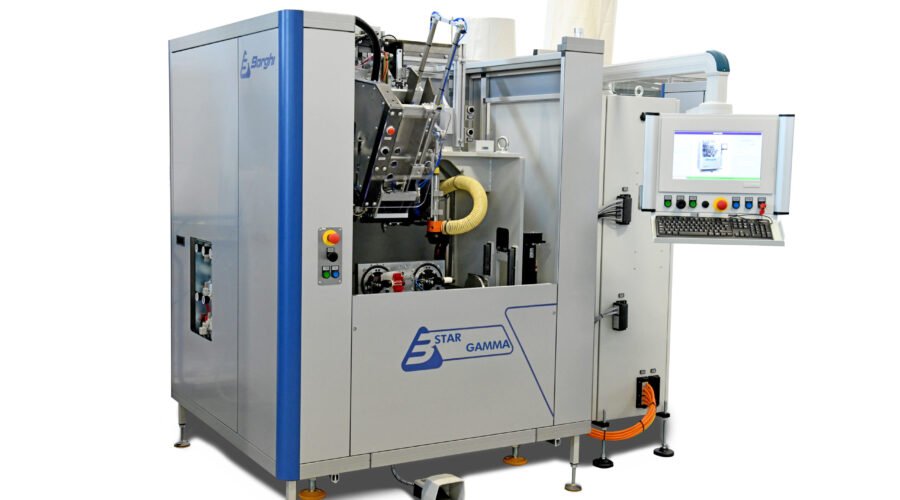
The cornerstone of a household brush manufacturing startup in this investment range is a vertical tufting machine. A 5-axis CNC brush machine with 1 filling tool and 1 drill, capable of producing at 450 tufts per minute. It supports the full range of household brush types – flat brushes with radial or upright filling, round head toilet brushes, and double hockey toilet brushes – making it the ideal first machine for a focused household brush production operation.
The total investment in this range comfortably covers the Brush Tufting Machine itself, along with a brush finishing line (Roto Trim for trimming and Roto Flag for flagging) and ancillary equipment such as an Air Compressor and Servo Stabilizer.
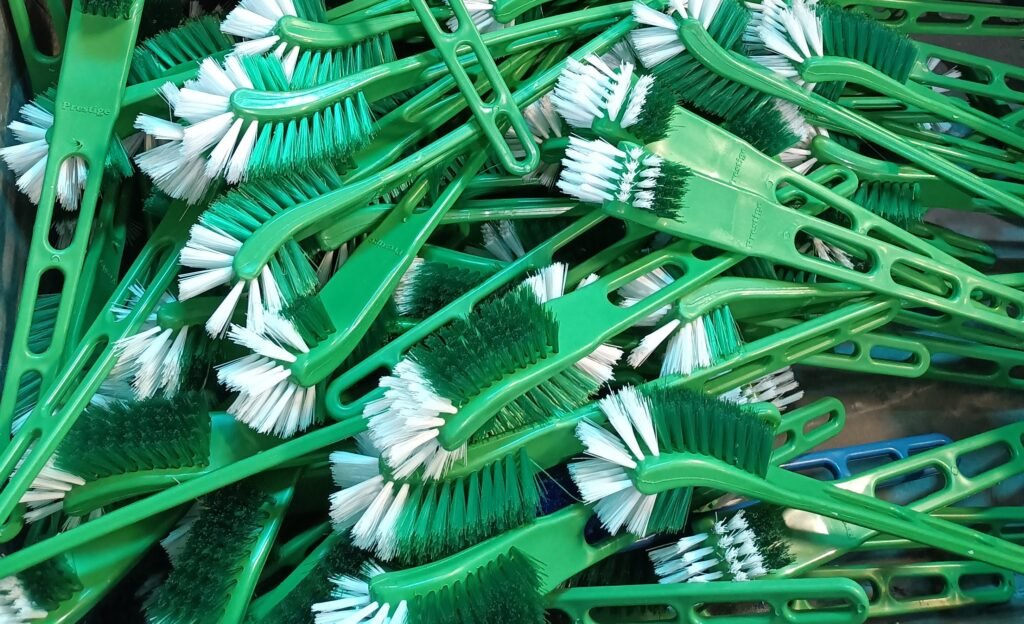
It also covers an initial stock of PP filament, PET filament, and natural fibres like Palmyra and Cocoa fibre, along with Metal Wire and working capital for handle sourcing and packing materials.
The brush business profit margin on household brushes is healthy and relatively quick to realize – because the product category moves fast, the raw material supply chain is well-established.
| KEY FACT | A typical Brush Tufting Machine from a reputed supplier consumes just 2.6 kW of power during production – keeping electricity costs minimal relative to output volume. |
2. Market Potential: India’s Brush Demand Is Enormous and Structurally Growing
India has over 300 million households. Each one uses at least 5 types of brushes, going up to 12 at times – floor brooms, toilet brushes, dish brushes, scrubbing brushes, cloth washing brushes, and more. These products wear out. They are replaced routinely. The brush demand growth in India is not aspirational – it is built into the fabric of daily domestic life.
A Recession-Resistant Category
The household cleaning market is part of India’s broader FMCG cleaning products segment, which continues to expand even during economic downturns. When disposable incomes tighten, households clean their own spaces more frequently – and they still need brushes to do it. This structural demand makes brush business profitability remarkably resilient compared to discretionary product categories.
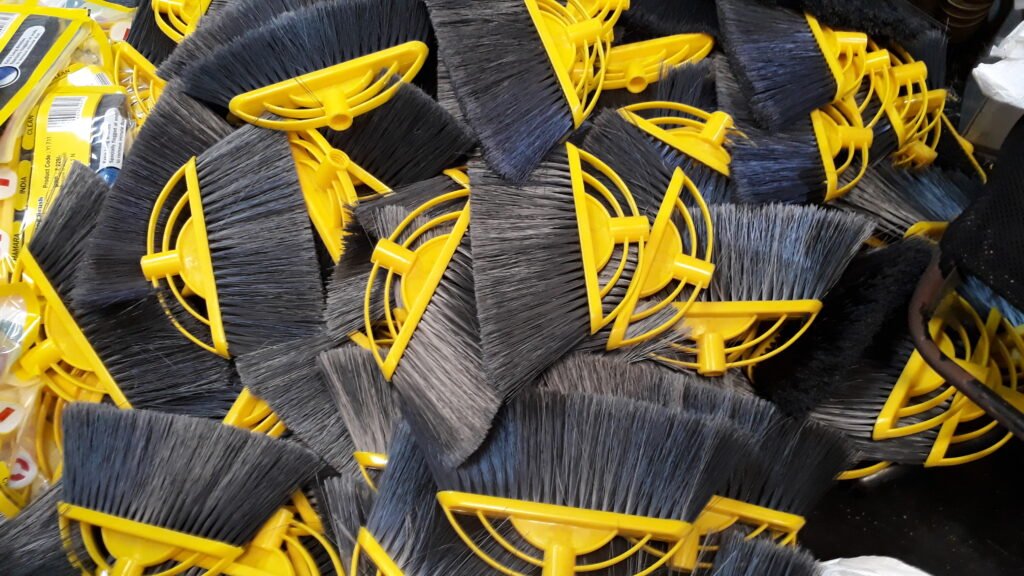
Additionally, the shift from unorganised street vendors to organised retail – modern trade, regional supermarket chains, and e-commerce platforms – is creating strong demand for branded, quality-finished brushes that command better margins than commodity products. The toilet brush market and premium broom segment are growing fastest in Tier 1 and Tier 2 cities, where consumers are willing to pay more for aesthetics, durability, and hygiene.
Export and Import Substitution Opportunities
India is increasingly competitive in brush export opportunity markets, particularly across South Asia, the Middle East, and Africa.
The import substitution manufacturing angle adds another dimension: a wide range of specialty household and semi-industrial brushes are currently imported, representing a direct opportunity for domestically produced alternatives.
3. Small Manufacturing Footprint – Starting From Just 3,000 Sq. Ft.
Unlike steel fabrication, chemical processing, or food manufacturing, which demand sprawling facilities with complex utilities, a small-scale brush factory is genuinely compact. A fully functional brush production setup using the Star Gamma machine and its finishing accessories can be housed in a space starting from 3,000 sq. ft., making it suitable for industrial estates, industrial clusters, as well as semi-urban and rural locations across India.
Factory Layout: How 3,000 Sq. Ft. Is Organized
| Machinery | Approximate Area |
|---|---|
| Tufting Machine | ~500 sq. ft. |
| Finishing Line (Trimmers) | ~200 sq. ft. |
| Air Compressor & Servo Stabilizer | ~100 sq. ft. |
| Raw Material Storage (Filament, Handles, Wire) | ~600 sq. ft. |
| Finished Goods & Packing | ~700 sq. ft. |
| Quality Check & Admin | ~400 sq. ft. |
| Movement Aisles & Utilities | ~500 sq. ft. |
| Total Minimum Operational Area | ~3,000 sq. ft. |
The compact footprint translates directly into lower rent costs and faster factory setup timelines. As brush production ROI improves and volumes scale, adding a second machine or expanding into a larger adjacent unit is straightforward – no structural change to the business is required, just floor space.
4. Lean Workforce – A Viable Operation With Just 3 to 4 People
Labour intensity is one of the primary risk factors for small manufacturers – high headcount means high fixed costs, compliance obligations, and productivity variability. The Brush Tufting Machine elegantly solves this through CNC-controlled automation and intuitive machine design. High-end Brush Tufting Machines incorporate Industry 4.0 software with alarm diagnostics that allow operators to detect and locate faults immediately – no specialist maintenance engineer required.
The Minimum Viable Team
A starting operation runs comfortably with 3 to 4 people:
- Machine Operator (1 person): Manages the CNC Brush Tufting Machine – loading brush blocks, monitoring filament feed, and overseeing the production cycle. No prior brush industry experience is needed.
- Finishing & QC Operator (1 person): Runs the Trimming machines – trimming, flagging, and beating – and conducts quality checks on finished brushes for consistency of filament length, tuft density, and appearance.
- Packing & Stores (1–2 persons): Receives raw materials (filament, handles, packaging), manages finished goods inventory, and coordinates dispatch to trade customers or e-commerce fulfilment centres.
5. Expand Into a Wide Range of Cleaning & Hygiene Products
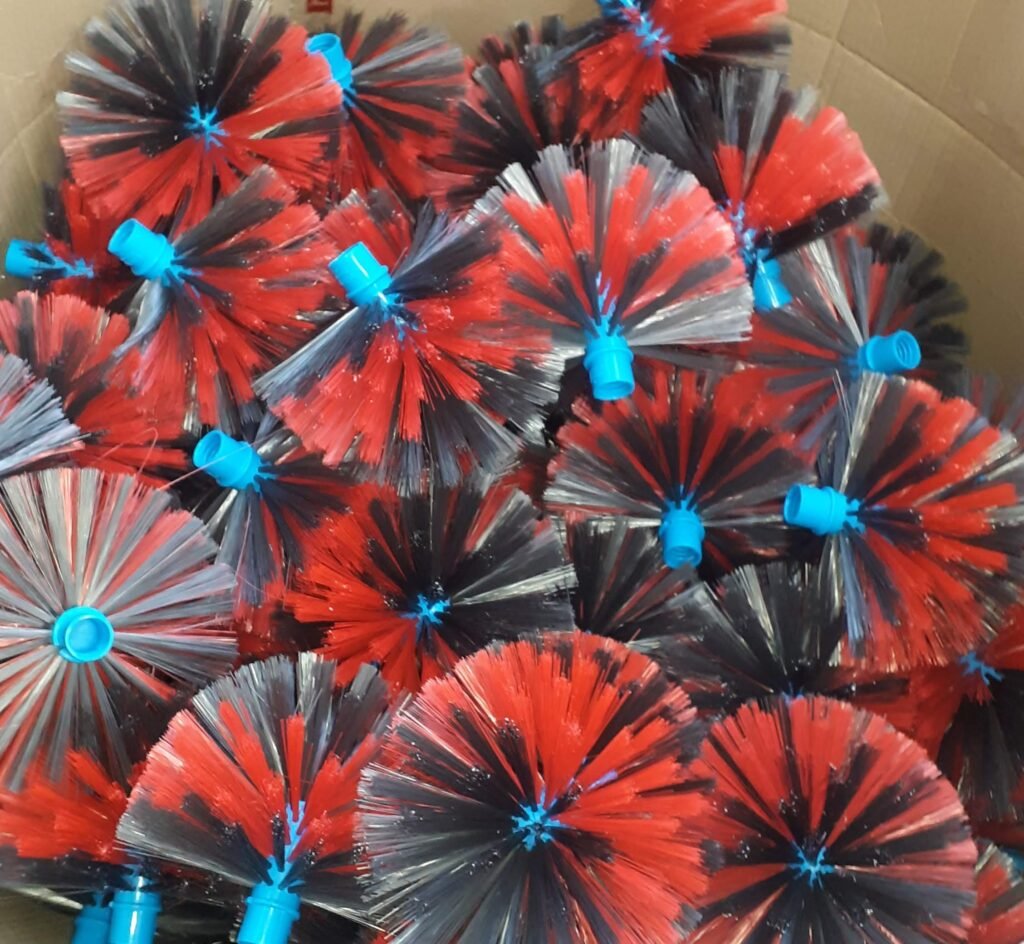
One of the most powerful attributes of the brush manufacturing industry is its product diversification potential. A business that starts producing basic brooms and floor brushes can – using the same machine infrastructure with different tooling and carriages – evolve into a manufacturer of a remarkably broad portfolio of household cleaning products and hygiene tools.
The cleaning product entrepreneur who starts with basic household brooms can – over 2 to 3 years – evolve into a full-spectrum hygiene product manufacturer, building a brand that competes across every shelf in the home care aisle.
6. The Perfect Add-On for Existing Household Product Manufacturers
If you already manufacture plastic household products – Buckets, Containers, Bottles, Tubs, Storage Boxes, Kitchen Utensils, Kitchenware, Houseware, Food Packaging Products or similar items – you are sitting on a ready-made platform to add brush manufacturing to your business. The synergy between these product categories is one of the most compelling aspects of the value proposition, and it is one of the core reasons the joint venture was structured specifically for Indian entrepreneurs.
Why the Fit Is Immediate and Natural
Consider what an existing household plastics manufacturer already has in place that directly benefits a brush production setup
- Shared raw material relationships: If you already procure PP (polypropylene) for buckets and containers, procuring PP for Brush Handles and filament for brushes is a natural extension – often from overlapping or adjacent suppliers. The same material procurement infrastructure serves both product lines.
- Unified distribution channels: Your existing trade buyers – hardware retailers, household goods wholesalers, supermarkets, and online marketplace partners – are also buyers of brooms, brushes, and cleaning tools. One sales call can now cover a broader catalogue, increasing basket size per customer visit and improving your leverage with retailers.
- Existing factory infrastructure: Industrial sheds, 3-phase power connections, air compressors, material handling equipment, and basic utilities are already in place, substantially reducing the incremental capital expenditure required to set up a brush production line.
- Injection moulding know-how: Brush handles are injection-moulded plastic components. If you already operate or commission moulding for your current product range, brush handle moulds are a natural adjacency.
- Established business compliance: GST registration, factory licence, EPF/ESIC registration, and banking relationships are already in order – zero administrative duplication required.
The brush industry startup in India has never been more accessible for entrepreneurs already operating in plastic household goods manufacturing. The machines are compact, the training is comprehensive, the raw material supply chain is mapped and provided to you upon purchase, and the household brush demand growth is structural and ongoing. It is a win-win situation for all customers.
Conclusion: A Clear Path to a Profitable, Scalable Manufacturing Business
The Brush Tufting Machine investment proposition is rare in Indian manufacturing: low capital entry, minimal space requirements, a lean team, a proven product category with structural demand, a full technical support ecosystem, and the ability to diversify into an ever-expanding portfolio of household cleaning and hygiene products.
For entrepreneurs already in household plastics, packaging, or consumer goods manufacturing, the case is even stronger – the raw material, distribution, infrastructure, and compliance overlap is immediate and substantial. For first-time manufacturers, the training and commissioning model ensures that entry barriers are genuinely low.
With an investment range of ₹50 lakh to ₹1 crore, a 3,000 sq. ft. factory floor, a team of 3 to 4 people, and the Star Gamma vertical tufting machine at the heart of your operation, you have everything you need to build a profitable, scalable brush manufacturing business in India – one that serves a market that cleans up, every single day.
About the Author
Rajiv Sanghavi is the Managing Director of BORGHI India and contributed the technical expertise and industry insights for this feature.
The article has been reviewed and edited by the editorial team of Brushes, Hairs & Fibres prior to publication.